
10 Reasons Your Car’s Electrical System Isn’t Working (And How We Fix Modern Gremlins)
It’s a chilly morning in Airdrie. You hop into your driver’s seat, turn the key or press the start button, and… nothing. Or perhaps worse, your dashboard lights up like a chaotic Christmas tree, your radio starts cutting out, and your power windows move with the lethargy of a tired sloth.
Electrical issues are the “ghosts in the machine” of the automotive world. They are frustrating, unpredictable, and often leave even seasoned DIYers scratching their heads. Unlike a mechanical failure: where you can often see a broken belt or smell a leaking fluid: electrical problems are often hidden deep within miles of copper wiring and complex silicon chips.
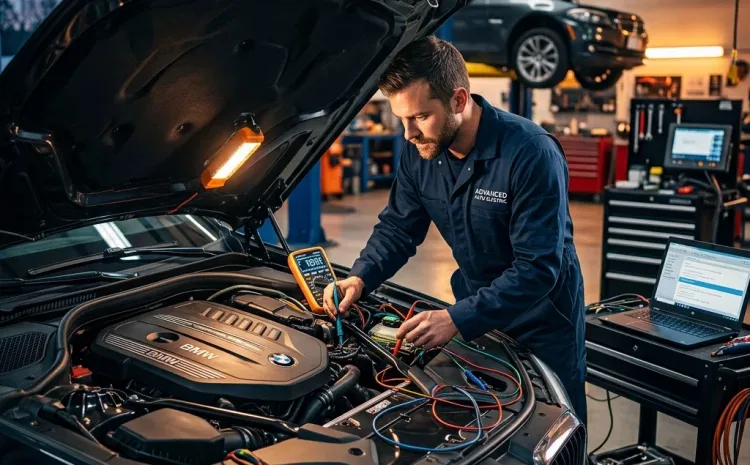
At Tools in Motion, we don’t just swap parts and hope for the best. We specialize in car electrical repair in Airdrie, providing the deep-level car diagnostics Calgary drivers rely on when the local dealership hits a wall. If your vehicle is acting possessed, here are the 10 most common reasons your electrical system is failing: and how we track down those modern gremlins.
1. The Battery: More Than Just a “Starter”
The battery is the heart of your car’s electrical system. While most people think of it only in terms of starting the engine, it also acts as a massive voltage stabilizer for the entire vehicle.
In our climate, extreme temperature swings can kill a battery’s chemistry. If your battery is more than three to five years old, it may lack the “reserve capacity” to keep your car’s computers happy. Modern vehicles are incredibly sensitive; even a slight drop in voltage can cause various modules to report “low voltage” codes, leading to a cascade of phantom warning lights.
2. The Alternator: Your Onboard Power Plant
If the battery is the heart, the alternator is the lifeline. It’s responsible for recharging the battery and powering all electrical components while the engine is running. When an alternator begins to fail, you might notice your headlights dimming at stoplights or a whining noise coming from under the hood.
We often see “intermittent” alternator failures where the unit charges perfectly one minute and drops off the next. Our auto diagnostics allow us to stress-test the charging system under full load to ensure you won’t be stranded on the side of the Deerfoot Trail.

3. Corroded or Loose Connections
Think of electricity like water flowing through a pipe. Corrosion is like a big clump of rust inside that pipe: it creates resistance. In Airdrie and Calgary, our road salt is a silent killer for electrical grounds.
A loose ground wire or a corroded battery terminal can cause your car to behave erratically. You might lose power to your radio every time you hit a bump, or your car might refuse to start despite having a brand-new battery. We use specialized tools to perform “voltage drop testing,” which helps us find exactly where the “blockage” in your electrical pipes is located.
4. Blown Fuses and Faulty Relays
Fuses are the “sacrificial lambs” of your car. They are designed to break if too much current flows through a circuit, preventing a potential fire. If your 12V outlet or one specific headlight isn’t working, a fuse is the likely culprit.
However, a blown fuse is usually a symptom, not the disease. If a fuse keeps blowing, there is an underlying short circuit that needs professional attention. Replacing the fuse with a higher-rated one is a dangerous mistake: it’s like putting a steel rod in place of a safety valve.
5. Modern Gremlins: Software and Module Failures
Today’s cars are essentially rolling supercomputers. They rely on “modules”: small computers that control everything from your transmission shifts to your seat heaters. Sometimes, these modules lose their “mind” or need a software update.
This is where Tools in Motion shines. While many shops have basic code readers, we perform advanced module programming car service. Sometimes a “broken” part isn’t broken at all; it just needs a software flash to fix a bug, much like updating your smartphone. You can learn more about why your vehicle might need module programming here.
6. Damaged or “Nibbled” Wiring
Wiring doesn’t just fail on its own: usually, something helps it along. This could be heat from the engine bay making insulation brittle, vibration rubbing a wire raw against the chassis, or “uninvited guests.”
Rodents love the soy-based wiring insulation used in many modern vehicles. A single mouse can cause thousands of dollars in damage in one night. Finding a chewed wire in a harness containing 50 identical-looking wires requires patience, a schematic, and a steady hand: all of which our team at Tools in Motion brings to every job.

7. The Starter Motor
You turn the key and hear a single “click” or a rapid-fire “machine gun” sound. That’s often the starter solenoid trying to engage. While the starter is a mechanical motor, its failure is almost always triggered by an electrical issue: either an internal short or a lack of sufficient amperage reaching the unit. Before we pull a starter, we always verify that the signal to the starter is healthy, saving you from paying for a part you didn’t need.
8. Parasitic Drains: The “Hidden” Battery Thief
Do you find your battery dead every Monday morning after the car has sat for the weekend? You likely have a parasitic drain. This happens when a computer module fails to “go to sleep” when the car is turned off.
It’s like leaving a flashlight on in the glovebox. Finding these drains requires hooking up an ammeter and monitoring the car’s electrical draw as each system shuts down. It’s tedious work, but it’s the only way to stop your car from eating batteries.
9. Faulty Ground Connections (The “Open Circuit”)
In automotive electrical systems, the metal body of your car acts as the return path for electricity. If a ground strap (a heavy wire connecting the engine to the frame) becomes loose or rusted, the electricity has nowhere to go.
This often results in “back-feeding,” where electricity tries to find a path through other circuits. Have you ever seen a car where the turn signals blink when the driver hits the brakes? That is a classic ground issue. It’s confusing to look at, but logical once you understand how the circuit is “searching” for a way back to the battery.
10. Aftermarket Interference
We love gadgets as much as anyone, but poorly installed remote starters, dash cams, or subwoofers are leading causes of electrical nightmares. If an installer “taps” into a sensitive data wire (like a CAN bus line) to get power, it can crash the entire communication network of the vehicle.
We often have to “undo” DIY wiring jobs to restore the vehicle to its factory state before we can even begin to diagnose the original problem.

Why Tools in Motion for Electrical Repair?
Many drivers think they have to go to the dealership for complex electrical work or module programming car service. The truth is, dealerships are often restricted by “corporate” diagnostic paths that lead to expensive parts replacement rather than actual repair.
At Tools in Motion, we serve the Airdrie and Calgary areas with a different approach. We use dealer-level diagnostic equipment but combine it with an old-school understanding of electrical theory. Whether it’s understanding module cloning or tracking down a broken wire in a door jamb, we have the tools and the patience to fix it right the first time.
Conclusion: Don’t Let the Gremlins Win
Electrical problems rarely fix themselves. In fact, they usually get worse, leading to more expensive “cascading” failures. If your car is acting up, don’t wait for it to leave you stranded.
Experience the peace of mind that comes with a truly professional diagnosis. Whether you are in Airdrie or commuting from Calgary, we are here to help you get back on the road with a vehicle you can actually trust.
Ready to banish the gremlins? Contact us today to schedule your deep-dive electrical diagnostic.