
More Than a Code: Why Advanced Car Diagnostics in Calgary Save You From the “Parts Cannon”
It’s a scenario almost every driver has faced. You’re cruising down the Deerfoot or navigating the streets of Airdrie when suddenly, a small amber light flickers to life on your dashboard. The "Check Engine" light. In an instant, your heart sinks. Is it a loose gas cap, or is your transmission about to give up the ghost?
For many, the first instinct is to head to a local auto parts store for a "free code scan" or to buy a cheap Bluetooth dongle online. You get a code: let’s say P0301: and the internet tells you that "Cylinder 1 Misfire" usually means you need a new spark plug. You buy the plug, swap it out, clear the light, and… two days later, it’s back. So you buy an ignition coil. Then an oxygen sensor. Before you know it, you’ve spent hundreds of dollars and several weekends under the hood, yet the light remains.
In the industry, we call this "firing the parts cannon." It’s an expensive, frustrating, and ultimately ineffective way to handle modern vehicle maintenance. Today, we’re going to look at why professional car diagnostics in Calgary are about so much more than just reading a code, and how a specialized mechanic in Airdrie can save you thousands of dollars by finding the root cause the first time.
The $20 "Flashlight" vs. The Surgical Laser
To understand why your basic code reader isn't enough, we need to understand what it actually does. Think of a standard OBD-II code reader as a flashlight in a dark room. It can show you that there is a box in the corner, but it can’t tell you what’s inside the box, how it got there, or if the floor underneath it is rotting away.
Most basic scanners only access the "Global OBD" side of your car’s computer. This is a regulated, generic set of data related primarily to emissions. While it can point you in a general direction, it often misses the nuanced "manufacturer-specific" data that tells the real story.
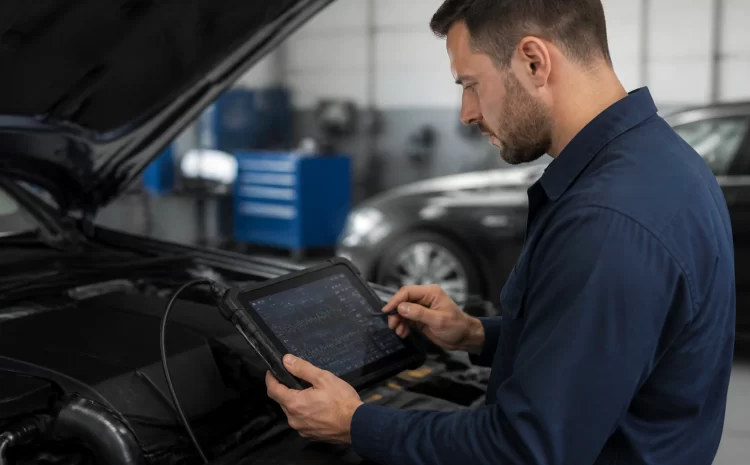
When you bring your vehicle to Tools in Motion for auto repair in Airdrie, we aren't just looking for a code. We use dealer-level diagnostic platforms that act more like a surgical laser. These tools allow us to "talk" to every single module in your car: from the engine and transmission to the ABS, airbags, and even the body control modules that manage your power windows and seats.
Beware the "Parts Cannon" (and Your Wallet's Survival)
The "Parts Cannon" is a trap that catches both DIYers and less experienced shops. It happens when a technician (or a Google search) treats a diagnostic trouble code (DTC) as a definitive repair instruction.
Let’s go back to that P0301 misfire code. A code reader tells you the computer detected a misfire. It does not tell you why. The cause could be:
- A worn spark plug (the easy fix).
- A failed ignition coil.
- A clogged fuel injector.
- A vacuum leak near that specific cylinder.
- A mechanical issue, like a burnt valve or a worn cam lobe.
- A wiring harness chewed by a local Airdrie rodent.
- A failing Engine Control Module (ECM) that isn't sending the signal to fire.
If you just start replacing parts based on the code, you are guessing. Professional car diagnostics in Calgary involve a process of elimination based on evidence, not intuition. We use specialized equipment to test the components before we replace them, ensuring that every dollar you spend is a direct step toward a solution.

The Art of the Deep Dive: What We Actually See
When we perform advanced auto diagnostics, we’re looking at several layers of data that a basic scanner simply can’t reach.
1. Live Data and Freeze Frame
When a fault occurs, your car’s computer takes a "snapshot" of everything happening at that exact microsecond. This is called Freeze Frame data. We can see exactly how fast you were going, what the engine temperature was, and even the fuel trim levels at the moment the light triggered. This helps us replicate the problem. If the misfire only happens when the engine is under 25% load at 2,000 RPM, we don't need to waste time testing it at idle.
2. The Oscilloscope: Seeing the Invisible
Sometimes, the car's computer isn't fast enough to see a problem. This is where an oscilloscope comes in. It allows us to watch the actual electrical signals: the "heartbeat": of sensors and actuators in real-time. We can see the electrical "noise" from a failing sensor or a momentary drop in voltage that would escape a standard digital meter. This is crucial for solving those "ghost in the machine" electrical issues that haunt modern late-model vehicles.
3. Bi-Directional Control
This is a game-changer. Our advanced tools allow us to command the vehicle to do things. We can tell the computer to turn on a cooling fan, pulse a specific fuel injector, or cycle an ABS pump. By taking control of the system, we can verify if the component itself is working or if the problem lies in the wiring or the module's ability to send the command.
Why Specialized Diagnostics Matter for Drivers in Calgary
Cars today are essentially rolling supercomputers. Even a standard pickup truck or family SUV now contains dozens of interconnected computers (modules) communicating over a high-speed network. When one module "glitches," it can cause a chain reaction of warning lights that make your dashboard look like a Christmas tree.
For drivers around Calgary and Airdrie, our climate adds another layer of complexity. Road salt, extreme temperature swings from -30°C to +30°C, and heavy vibrations from gravel roads can lead to corroded connectors and brittle wiring. These issues rarely throw a "broken wire" code; instead, they throw "implausible signal" codes that lead most shops to recommend expensive module replacements.
At Tools in Motion, we pride ourselves on being the shop that other shops call. Our expertise in module programming and dealer-level service means we can often repair or reprogram existing components rather than simply throwing new ones at the problem.
Finding a Trusted Mechanic in Airdrie
When you're looking for a mechanic in Airdrie to handle a complex issue, don't be afraid to ask about their diagnostic process.
- Do they use oscilloscopes for electrical testing?
- Can they perform in-house module programming and cloning?
- Do they provide a detailed report of why a part failed, rather than just saying "the code said so"?
Honesty and integrity are the bedrock of our business. We know that car repairs are an unplanned expense, and the last thing you need is a "trial-and-error" approach to your vehicle's health. By investing in a proper diagnostic hour upfront, you almost always save money on the total repair bill by avoiding unnecessary parts and labor.
Conclusion: Peace of Mind on the Alberta Roads
Your vehicle is likely one of your biggest investments, and it’s certainly one of the most vital tools for your daily life. Whether you’re commuting into Calgary for work or taking the family out for a weekend in the Rockies, you deserve to have total confidence in your car’s reliability.
Don't let a "Parts Cannon" approach drain your bank account and leave you stranded. If your dashboard is glowing or your car is acting up, choose the experts who look beyond the code. Our team at Tools in Motion is here to provide the deep diagnostics and expert troubleshooting that keep Airdrie drivers safely on the road.
Ready for a worry-free driving experience? If you’re struggling with a stubborn warning light or a complex electrical issue, give us a call or stop by. Let’s get your car diagnosed correctly the first time so you can get back to what matters most.
Contact Tools in Motion today for the most advanced car diagnostics Calgary and Airdrie have to offer!